

collage as community
more about collage-o-rama, and what zines, letterpress, & collage have in common

My summerlong collage workshop—”Is This Art?” is open for registration now! Join me every other Tuesday starting June 10th for collage fun, techniques, and lots more. Plus a guest artist, a mail exchange, and options to participate as much or as little as works for you.
I don’t have photos of collage meet ups because I am too busy collaging.
Collage people are welcoming folks. For artists who come from more solitary pursuits like painting, I can understand how the collaborative nature of collage can be surprising. Collage folks are comfortable borrowing from existing work, adapting images into different contexts. It makes sense that collage artists pass skills and techniques as easily as resources. Artists create their own work but tend to be open to communal approach with fluid collaboration, a willingness to pass on an unfinished idea, and showing up for collage meet-ups.
I embrace the forgiving nature of collage. I love that, because it is often made of forgotten or discarded items, one might mistake it for trash. Collage feels accessible because material are easy to access, can be gleaned from scrap or materials in your closet. At its simplest, collage can be tearing paper and using a glue stick to create. Collage can be cathartic, or a collection of ideas. It can be a way of gathering color samples, or make a political point with humor. Work can be intricate, or loose and expressive. Though sometimes dismissed by the Fine Arts Community, I am often not very interested in the Fine Arts Community. I like to share collage because the you probably already know the basics. From a scrap journal to public art to gallery shows to mail-based collaborations, collage is versatile and welcomes you.
The welcoming communities of printmakers, zinesters, and collage artists are why I teach these mediums.
By accident or temperament I am drawn to mediums that discourage competition. I often work along but love an opportunity to collaborate, share materials and knowledge. My first love is writing and as a teen I submitted poems to journals for publications. When I saw my first zines at 17, I embraced self-publishing, and the community of trading at shows and through the mail. Searching for creative approaches to zine making, I stumbled into printmaking. Printmakers, and in my experience, letterpress printers in particular, are aware of the potential of their medium. If you can make 100 of a thing, it looses preciousness without sacrificing its beauty or message. And if you are interested in a medium that relies on 100 year old equipment, and specific skills, it makes sense to welcome anyone interested in learning this tedious process.
The welcoming communities of printmakers, zinesters, and collage artists are why I teach these mediums. I teach collage because it is a great medium for sneaking in ideas about imperfection, about trying things to see what works, about loosing your expectations on any particular outcome. I teach collage because I want to teach adaptability, flexibility in thinking, and the potential for working together, and this is the best medium I know for that.
By accident or temperament I am drawn to mediums that discourage competition.
A few weeks ago, I hosted my first collage meet up in a while. I’ve hosted online and in-person meet ups, in Portland and New Orleans, as part of a group and on my own. This new meet up, Queerdo Collage (a nod to Weirdo Collage pals in Olympia) does not yet have regular meetings, but on a Saturday afternoon, twenty folks gathered at Honeyed Word Books to cut and paste.At meet-ups the lean towards generosity is clear. Some folks brought supplies for everyone. Folks sat in small groups and introduced themselves to strangers. When we quickly filled the space inside the bookstore and it became clear we had to move everything outside, everyone gathered up their things, grabbed chairs, and asked how they could help. Most attendees were strangers to me, responding to ads in two different queer events lists.
When I moved to Portland, I met some of my closest friends and collaborators through collage meet-ups. Many of the people at the Queerdo event were new to town. There is something about having something to busy your hands that makes it easier, even for shy or introverted folks, to chat with strangers. I love watching folks getting to know each other.
Two weeks ago I was in Seattle for the opening of Collage-A-Rama, a month long celebration of collage in Seattle, organized by Andrea Lewicki by Special Agent Collage Collective. I call myself a cheerleader for the project as I helped hang the art, organized a collaborative mission for SACC and Keep Writing, and volunteered to pour drinks for the opening. I appreciate the thoughtfulness of Special Agent Collage Collective because their missions strive to be inclusive across geography, gender (which seems like a given but isn’t always), ability, and experience with collage embracing newcomers.
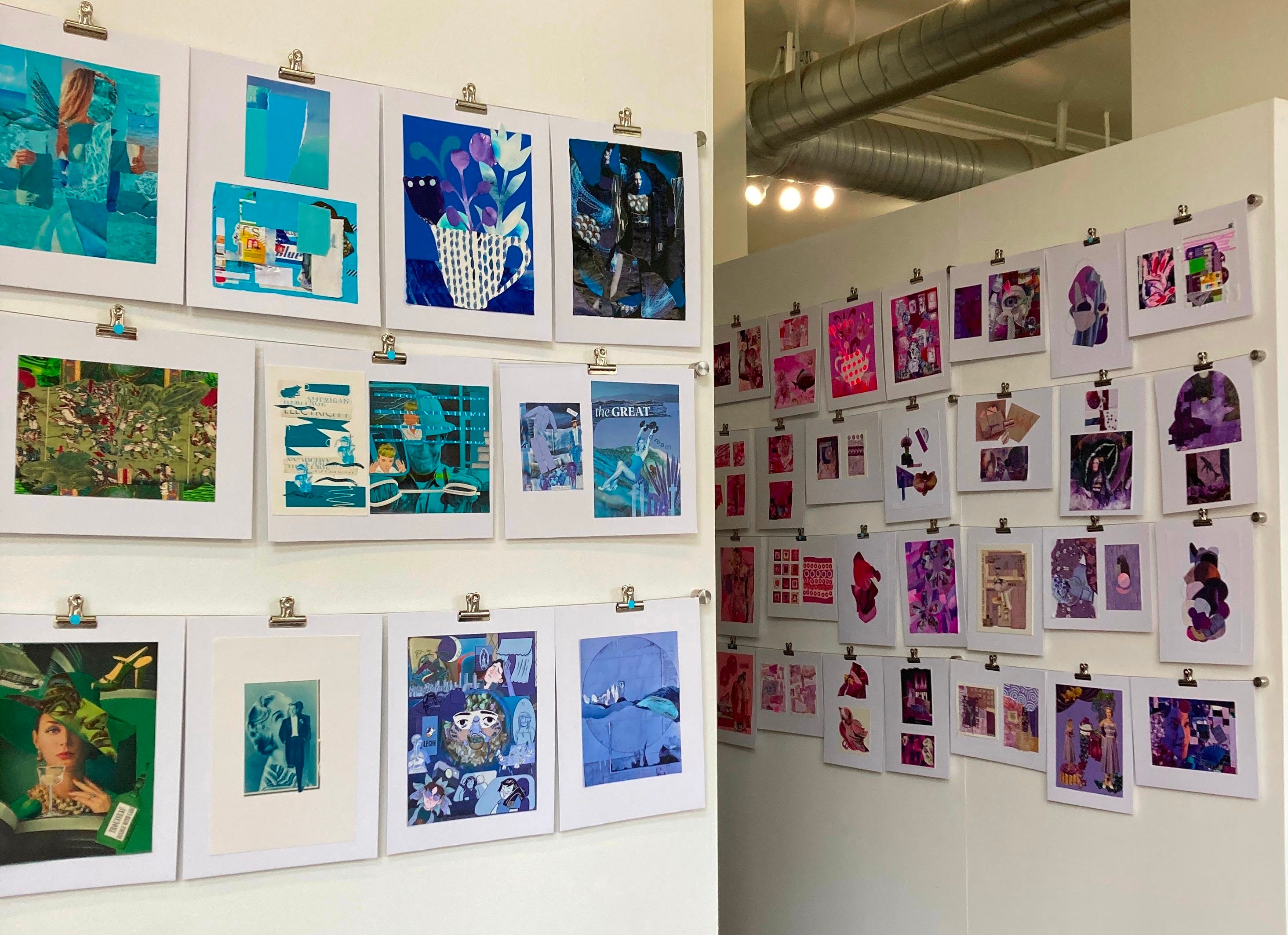
For opening night, during the Belltown Arts Walk, four work tables were placed in the gallery, with scissors and glue, with two additional tables for supplies. Folks were encouraged to sit and make a monochromatic collage in exchange for buttons made with images of some of the monochromatic works on display. I talked with kids, artists who had openings down the street but popped in and stayed to collage, and neighbors who happened to walk by.
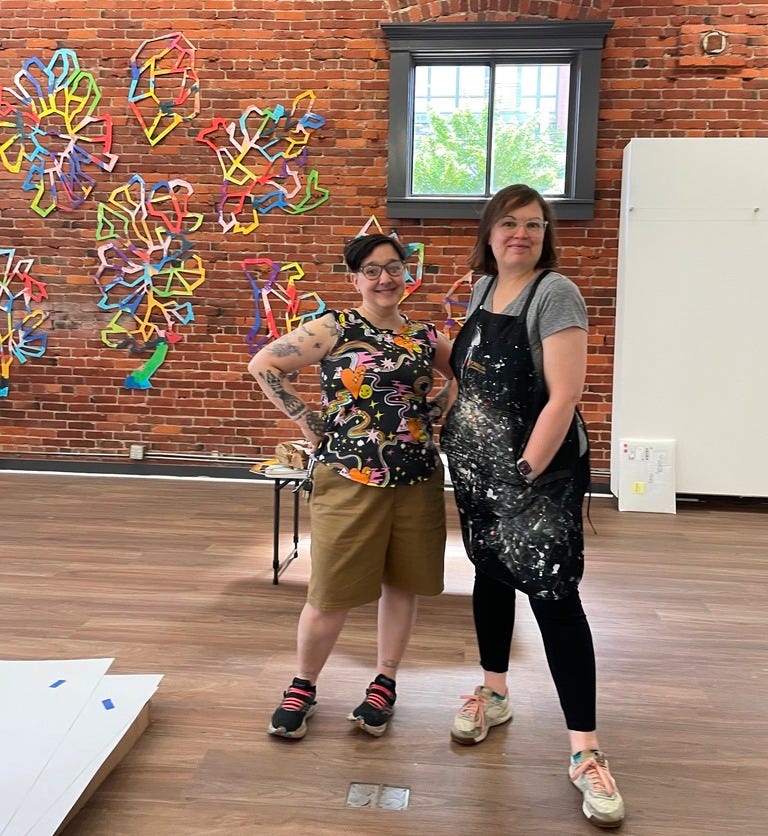
This years Collage-O-Rama accepted proposals to share a range of collage work. The scope included large scale paintings with collaged elements, a looped reel of digital collage, a wall of 3 dimensional blooms (which I wrote about last week) , postcard sized collaborations started by one artist and finished by friends, and an exquisite corpse project in its fifth year. Not only was the art varied, but it showed a number of ways of working together—through mailing one mission to strangers, one person allowing ten or so different people finish their work, a poet and a collage artist resounding to each others work, or in the hanging of large work, a collaborative process for the artist who had to direct someone else on a ladder.
Earlier this year, I helped to hand the Let ‘Er Rip show orchestrated by Torea Frey, (who wrote a newsletter about it, if you missed it) who served as the “connective tissue” between PNW collage artists, and a non-verbal artist who tears paper. Collage expands to size of the community open to the form. There is room for you.
There is much talk about community building as resistance, about the need to rely on the people around you when the government systems fail. In this sense, free, public places to gather and create together are revolutionary. Collage spreads joy, creates connections between strangers, offers another thread in our web, making it stronger.
Collage-O-Rama continues through June 7th. And the art is for sale, priced reasonably so fill your home with color!
bonus joy
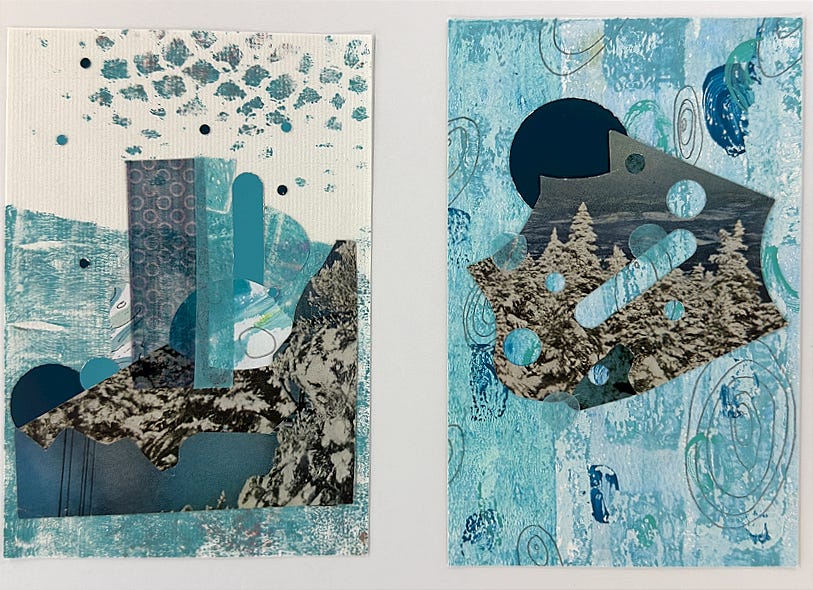
my cup overflows and so I share these with you:
"Though sometimes dismissed by the Fine Arts Community, I am often not very interested in the Fine Arts Community." I chortled. :D
Yes.